
Article by grapevinemagazine.ca
BOLD • LAYERED • TIMELESS
Possibilities in Paper and Paint
Original collage artworks inspired by nature and reimagined through colour, texture, and form.
ORIGINAL ARTWORKS | LIMITED EDITIONS | COMMISSIONS
Collage is an art form that is probably as old as paper, but came to particular prominence as a fine art practice at the beginning of the 20th century with the early Cubist experiments of Picasso and Braque and later, the Dadaist creations of Kurt Schwitters. The word collage, or papiers collé, derives from the French for glue and the verb to glue, so in essence it means creating images by assembling bits of paper on a surface.
Picasso, Braque and particularly Kurt Switters constructed their collages from bits and pieces found in everyday life, especially discarded items, such as bus or train tickets or pages torn from old newspapers.
Ken Prescott's approach to collage is somewhat different: instead of utilizing found objects, he prepares his own source material by painting directly on to pieces of paper and applying or discovering interesting textures created by a wide variety of tools, most of which are not typically used by artists.
Indeed, he jokes that his work room resembles a hardware store rather than an artist's studio. He may print the texture found on a leaf or ently piece of bark for example, and then seek a way to apply that. His quest is to create images from the application of textures created by this process.
Collage, as an approach to image making, offers certain compositional advantages over conventional painting, in that one can shuffle compositional elements around on the surface of the work without commitment until one is truly satisfied that a particular component works. If you want to move something a few millimeters this way or that way, one can. Collage offers a level of flexibility painting can lack.
Ken identifies another unique quality of collage - pentimento - which means the surface revealing what's underneath. The works are 'built, a word that implies an architectural sensibility, with an awareness of the effect of the lower layers on the upper ones - what he calls the bones or the skeleton of the work which shows through the paper and imparts a dimension found only in collage. This of course requires thinking in layers and working from the back of the work to the front.
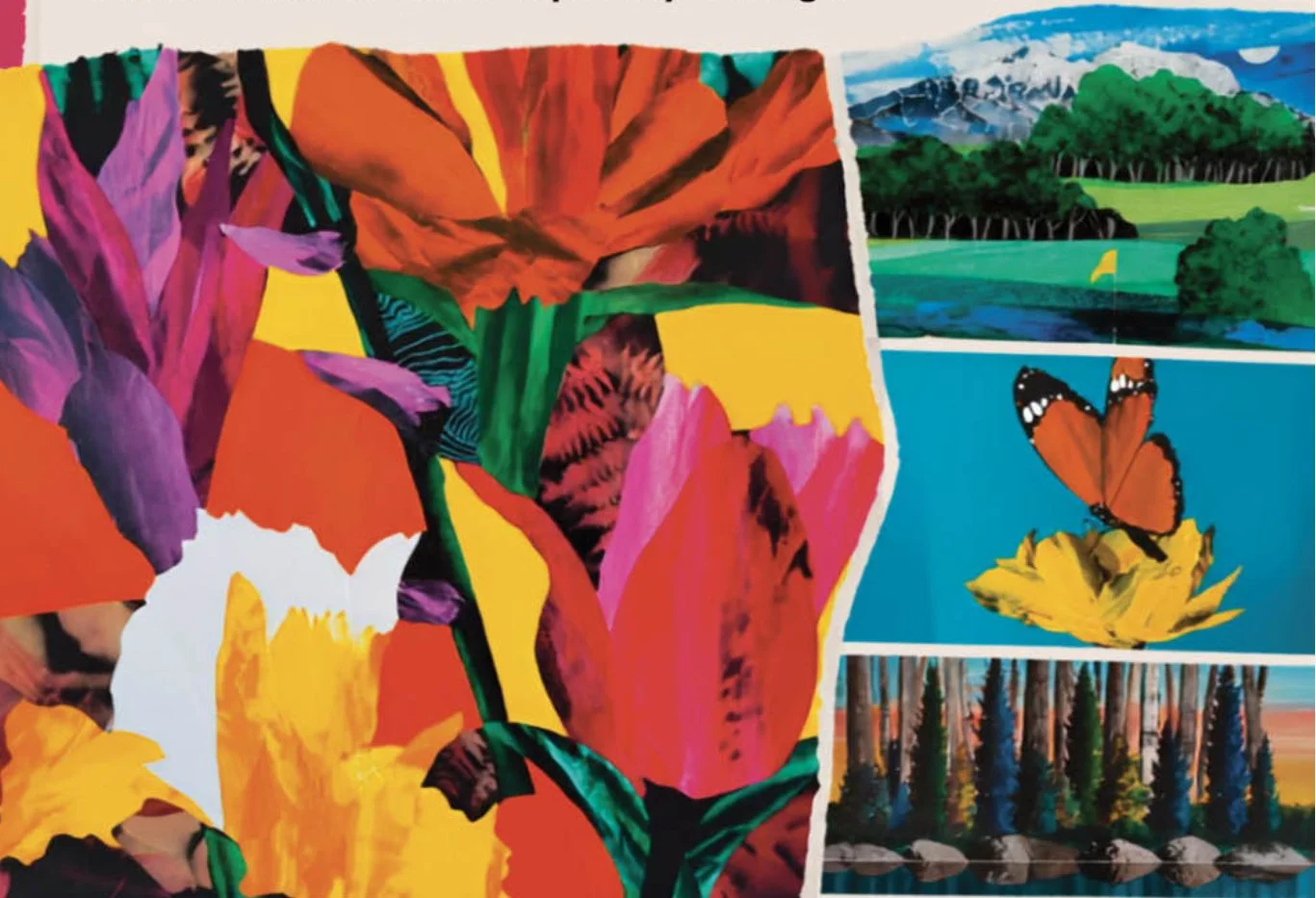
Richly textured surfaces promote light reflections and give an impression of three-dimensional depth and light bouncing off a body of water. Exploiting these qualities, Ken has produced a series of works premised on tropical fish with light filtering down from overhead. Many of the works are landscapes, but I feel they are more "created" than observed, applying and developing the qualities of the medium from his repertoire of textured surfaces. Backgrounds are painted first with a foam pad charged with several different colours, then the application of the papers begins. Though perhaps predicated in landscape, the work develops following its own internal logic
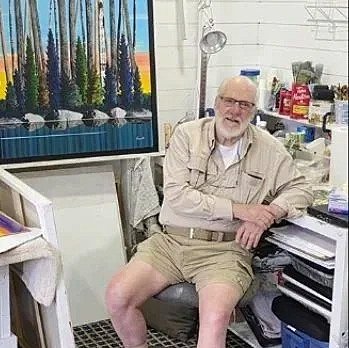
Remarkably, Ken is now 88, in great shape, and still working hard. He studied at Danforth Technical School in Toronto and moved into graphic design before becoming an art director. At that point his passion for painting was an activity confined to evenings and weekends.
His works are informed by the sites and scenes he has encountered on his travels round the world, travels which lasted four years and included visits to 57 countries including Africa, where he climbed Kilimanjaro, and Australia. Works inspired by those travels are referred to as Odysseys, a word currently popularized by a recent film, but for Ken the word reflects the true nature of his travels which was most certainly not first class transportation and accommodation in five-star establishments. Rather he hitch-hiked his way around and spending a night in a field was not an unknown experience. To keep his ship afloat he did anything that would pay, including tuning a piano, digging graves, harvesting peas, and even cleaning tombstones.
It was in Africa that Ken discovered his technique and it was a case of necessity being the mother of invention: he had wanted to paint but couldn't find any art supplies to buy, so he improvised, tearing up pieces of coloured paper from old magazines, and sticking them together with a glue stick.
He "didn't think much about it" until a while after when he realized he was on to something unique.
The works are distinctive, clearly recognizable, and strikingly impactful with strong design elements betraying Kens graphic design background. Mostly they are landscapes featuring mountains and bodies of water inspired by several years of living in British Columbia. Some are mysterious islands that remind me of Arnold Bocklin, but apparenty there is no connection.
Made by hand. Meant to be felt.
If you would like to see more of Ken's work, he is participating in the Kawartha Autumn Studio Tour show at the Peterborough Public Library's Community Artist Hub (345 Aylmer Street) Sept. 26-27 from 10 a.m.-5 p.m., kast.agp.on.ca.